Showing posts with label Art. Show all posts

Thursday, October 21, 2010

Don't Waste Your Time

Terry Teachout says you shouldn't waste your time. I agree:
As a professional critic, it's my job--my destiny, you might say--to spend a fair amount of time experiencing art that I don't like. Insofar as possible, though, I don't propose to waste any more of the days that remain to me consuming bad art than is absolutely necessary. Unless I'm being paid to do so, I won't even finish reading a book I don't like, or listening to a record that fails to engage me. I have better things to do, and not nearly enough time in which to do them.

Read the whole thing for more about traveling light.

Tuesday, August 10, 2010

Ken Burns, Reality TV, Narrative

Andy Dehnart at Reality Blurred picks up on something the documentary-maker Ken Burns said in a speech recently about the purpose of narrative:
Narrative is a way that we all superimpose something over something that’s essentially chaotic. Narrative gives us comfort. It gives us a false sense of security, often. It abolishes demons and trauma, and so I think that story has a very complicated origin for all of us, and we all desire—part of the whole nuance, I think, of this film has to do with the fact that we so want to know who should be in and who should be out, who’s bad and who’s good, and we know from our own lives, and we know from the kinds of compromises, human compromises that we make in the interstitial moments of our own personal lives that so much of it we just have to accept this is just the way it is. You go to the ballpark and it rains, and that’s what happens. … You can’t abolish that chaos. That, in fact, the great, ultimate payoff of narrative is that it both superimposes order and also reminds us of how chaotic it is, and that’s the beauty.

Dehnart then extends this to reality TV - the appealing thing about reality TV are the narrative arcs - but I'd go even further and say that this is what fuels the human impulse to create art: the urge to establish order over chaos. Whether it's art, music, writing, dance - the art that appeals to us most is that which brings order to our chaotic world.

I'm a fan of reality TV - American Idol, America's Got Talent, The Amazing Race and, uh, The Bachelor(ette) - so I won't slag on your choice but if you're a fan, too, I suspect the appeal is the same: the narrative that creates a compelling story.

Tuesday, December 1, 2009

Tim Burton at the Museum of Modern Art

The Museum of Modern Art has a new display of film director Tim Burton's art:

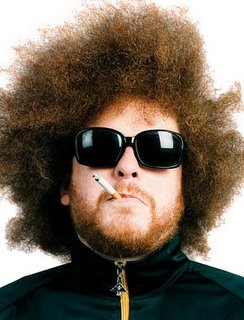
In photographs, Tim Burton looks the part of the goth filmmaker: rumpled and slightly menacing, his grizzled locks untamed, his expression surly behind a barricade of tinted blue glasses. In person, though, the 51-year-old auteur is surprisingly warm and fuzzy, more like an eager teenager stumbling over his sentences and punctuating his speech with jabbing, agitated gestures.

It may be Mr. Burton's connection with his inner adolescent that accounts for the string of hit movies that deftly blend creepiness and dark humor—"Edward Scissorhands," "Batman," "The Corpse Bride," "Charlie and the Chocolate Factory," to name only a handful of the 14 that he's conceived and directed over the past 25 years. But it's his restless hands and imagination that have produced since childhood hundreds of doodles, sketches, cartoons, puppets, storyboards, photographs and fully realized drawings, many of them on display in the Museum of Modern Art's retrospective of Mr. Burton's works.

Some things for creative types to take from this:

1.) Creative types create. Burton was driven by his own unique vision to create his work and that's what he did: he created. He didn't spend time in a coffee shop or bar talking about what he was going to do. He did it.

2.) Location helps. Burton's talent got him into the Disney Institute but his living close by helped. So he went to where art was being created. With the miracle of the Internet, actual location isn't quite as necessary has it has been in the past but virtual location helps. Seek out and find other creative types.

3.) Don't get discouraged. Burton didn't start out directing blockbuster movies. And when he did direct blockbuster movies, he directed some movies that weren't. (Hello, Planet of the Apes remake?) He kept moving right along. Success is nice but failure isn't the end.

Saturday, November 7, 2009

Hunting Down Ideas

I'm following Wil Wheaton on Twitter and his blog feed on Google Reader and he's immensely entertaining in his nerdy way. (What? You don't know who Wil Wheaton is? And you call yourself a Trekker.) Warning: if you click through below and browse his site, you'll find he sometimes he uses salty language.

I'm not sure I entirely agree with this post about the pursuit of ideas, though:
As writers, it's vital that we meet our deadlines, of course, but we also have to build time into our work schedule to read books, take walks, visit doctor whisky, play with our dogs, and do the other things that may not look or feel like work, but are integral to our creative process.

I think this is true of everyone, not just people who pursue creative endeavors. No matter your profession, what you do in your every day life feeds it. Or should.

And, besides, writers and artists should pursue their passions as a profession as well. That means you don't sit around and wait for inspiration to strike. You produce. You don't produce, you don't eat. Hunger is a great motivator.

I like how Bradbury put it about inspiration. Just jump off the cliff. Build your wings on the way down.

So, if you're an artist, what are you waiting for? Jump!

Thursday, November 5, 2009

Leonardo's Atlantic Codex, on Display at the Biblioteca Ambrosiana in Milan

This looks fascinating:
The Biblioteca Ambrosiana, which opened as one of Europe's first public libraries in 1609, would rank as a major tourist attraction in almost any other country. Its art gallery features paintings by Leonardo, Botticelli, Titian, Caravaggio and the full-scale "cartoon" (or preparatory drawing) for Raphael's monumental fresco of "The School of Athens" in the Vatican Museums.

At least as precious, but ordinarily visible only to scholars, is the Ambrosiana's collection of manuscripts and rare printed books. Holdings include a fifth-century illuminated copy of Homer's Iliad and a 14th-century edition of the works of Virgil, with hand-written annotations by the Renaissance poet Petrarch. Yet no item in the library's possession can be more intriguing to experts and laymen alike than Leonardo's Atlantic Codex.

With 1,119 pages of drawings and notes, almost all of them in Leonardo's own hand, the Atlantic Codex is by far the largest set of works by the archetype of universal genius. Leonardo's more famous Codex Leicester, currently the property of Bill Gates, is only 72 pages long.

Clearly the work of a lifetime but, still, at 1,119 pages, Leonardo was not only a genius but a hard worker. Which should serve as a lesson to the talented - of which, I'm not one, alas: talent without hard work is meaningless. You gotta get up every day and put in the work.

Wednesday, August 5, 2009

Lack of Donors Put Culture on Hold in Colorado

Wah! The economy is in shambles and culture
crumbles:
The economic downturn is making it harder for Denver's cultural institutions to raise money for planned expansions and scheduled events.

As a result, organizers delayed the groundbreaking of a new art museum that will display the works of Clyfford Still. The Colorado Symphony Orchestra is still judging just how ambitious a redo of Boettcher Concert Hall it should ask donors to help pay for. And the Denver Museum of Nature & Science has a multi-million-dollar hole to cover to pay for plans for a new education wing and collection storage facility.


Hmmm. Sounds like what's really suffering is everything but the culture itself. Curators and caretakers seem oblivious to the fact that culture can thrive quite well without them. In fact, it's their over-inflated sense of self-importance that allows artistic silliness to survive when in the free market of ideas they deserve to wither and die on the vine.

Ungrateful talk from someone who just posted about enjoying the local art museum? Maybe so. But we paid our entry fee to enjoy the art we viewed; if the price had been higher because the exhibit wasn't underwritten, well, that's an economic decision we'd have to make. Just as the museum makes its own economic decisions. I have a feeling we'd find a way to enjoy art just the same without the benefit of tax free donations. Which, come to think of it, is another way we all pay to sustain the culture.

Anyway, at least one benefactor in the linked story has its priorities straight:
We normally try to give in the area of education and health care, but we gave a grant this year to help feed seniors because it's hard to be healthy if you can't eat,' said Roxane White, director of the Timothy and Bernadette Marquez Foundation.

Hard to enjoy culture, too, if you're hungry and sick.

Oklahoma City Art Museum - The Impressionists

There were no movies we wanted to see this past weekend so went to the
Oklahoma City Art Museum's Turner to Cezanne showing of Impressionist artwork. The girls didn't want to go so we were whine-free the entire time.

(Learn more about Cezanne here. Turner, here.)

Beautiful collection. I like the Impressionists because I get a sense of true emotion from looking at their pictures and not in the I'm-angry-because-I-don't-get-it sense when we wandered over to the abstract collection afterward. And in no small stroke of serendipity, Cezanne was one of Hemingway's favorite painters; read Hemingway's "Big Two-Hearted River" and look at Cezanne's work and tell me if you don't get the connection. A great way to spend a Saturday afternoon.

We strolled through the other collections - we'd seen most of them before and, as I said, the abstract stuff for us is a waste of time. It's the triumph of marketing over good sense. Come on, admit it. You don't like abstract art, either.

But the Chihuly glass is well worth seeing again. Here are the obligatory shots of the Dale Chihuly Glass collection that you're required to take when you visit:


Cell phone camera. Looking straight up. Could be better but, hey, not bad.

So, a great afternoon. I hope we have more Saturday's with movies we don't want to see.

Friday, July 24, 2009

‘Yellow Submarine’ Graphic Designer, Dies at 75

The man responsible for the look of the Beatles animated movie, The Yellow Submarine, has died:
Heinz Edelmann, the multifaceted graphic designer and illustrator who created the comically hallucinogenic landscape of Pepperland as art director for the 1968 animated Beatles film “Yellow Submarine,” died on Tuesday in Stuttgart, Germany. He was 75.

I never found the landscape of the movie to be hallucinogenic - it just seemed to follow a cartoony logic all its own. But seeing this reminds me that the girls' might enjoy seeing the movie.


It's been years since I've seen it. I'd enjoy seeing it again, too.

(Via Althouse.)

Tuesday, May 12, 2009

Helprin Makes His Case

Helprin makes his case:
New technologies will always demand and deserve careful navigation and difficult readjustments. But the weakening or de facto abolition of copyright will not merely roil the seas, it will drain them dry. Those who would pirate what you produce have developed an elaborate sophistry to convince you that they are your victim. They aren't. Fight back.

(Here's what all the fuss is about.)

Friday, May 1, 2009

Lion King - Review

The road version of the Broadway musical of The Lion King is in town for a few weeks and Clara had snagged us tickets some months ago. We went last night - yeah, a work and school night, which made for a late night but you know, that's just how we roll around here. Clara'd managed to get us good seats - I think that should be yet another department she should be in charge of - and so we settled in for what we'd heard would be a great show.

Of course, we weren't disappointed. My favorite things about the show were the costumes and the puppets and sets. You always had the sense you were seeing something extraordinary and how they managed to pull off some of the scenes from the movie was quite clever. The wildebeest stamped was especially effective with the forced perspective of the puppets giving you a sense of greater depth than there actually was.

Since we're a rabid Disney family and since the movie has been a part of our lives since Rachel was born and throughout all of our numerous trips to Disney, the expansion of the story with extra songs and scenes were the least effective parts for me. Time to check my watch. But if there's someone out there who's new to the story, maybe they found it fascinating. Still, though they weren't my favorite parts of the play, the scenes were as effectively staged and choreographed and sung as any other original part of the story.

The play's been around for a while and the show's playbill says it's been seen all over the world. I'm glad it finally came to town and we got a chance to see it. Quite an accomplishment.

Thursday, April 23, 2009

Cezanne Exhibit: A Father of Modern Art and His Many Progeny

I don't pretend to understand modern art but I like the impressionists. The Philadelphia Museum of Art has an exhibition of Cezanne that sounds interesting:
For many modern artists Paul Cézanne was a talismanic figure, the shadow of his painting as impossible to escape as his achievement was to define. Throughout the 20th century, as scholars labored to construct a viable history of modern art, Cézanne (along with Manet, Courbet and a handful of transgressive others) was posited as its fountainhead, the protean begetter whose countless artistic progeny shaped a new aesthetic that placed vision and touch above traditional formal and narrative concerns.

Both Matisse and Picasso would claim Cézanne as a father, and almost every variant of 20th-century art could trace some aspect of its origins to his painting. Cézanne's effect on later artists has become the stuff of exquisite exhibitions, heated debate, and a linear notion of modernism. Without thoroughly disrupting that tidy critical trajectory, the Philadelphia Museum of Art's current exhibition, "Cézanne and Beyond," moves it onto more fluid and fertile ground, and the results are highly satisfying and visually thrilling.

Um, okay. I just think his pictures are purty. (My preference is Van Gogh and Monet; they manage somehow to convey powerful emotions.) More importantly, my favorite writer, Hemingway, set out to write like Cezanne painted and that's reason enough for me to enjoy Cezanne. Hemingway's "Big, Two-Hearted River" is nothing if not an impressionistic painting of a deceptively simple fishing trip that manages to convey emotion through the terse descriptions of the landscape and action.

Go ahead. Treat yourself to both Hemingway's story and Cezanne's pictures. You'll thank me for it.

Saturday, November 15, 2008

Stone Age Temple May Be Birthplace of Civilization

Interesting:

The elaborate temple at Gobelki Tepe in southeastern Turkey, near the Syrian border, is staggeringly ancient: 11,500 years old, from a time just before humans learned to farm grains and domesticate animals.

According to the German archaeologist in charge of excavations at the site, it might be the birthplace of agriculture, of organized religion — of civilization itself.

"This is the first human-built holy place," Klaus Schmidt of the German Archaeological Institute says in the November issue of Smithsonian magazine.

I think it's not only telling that from the very beginning, humans felt not only a need to build altars to God but to recreate the environment around them in their own terms. Here's the accompanying picture to the article which shows a relief of a fox chipped into the rock:


Art, religion. They go hand in hand with civilization.

Thursday, November 13, 2008

‘Leave It to Beaver’ Actor to Show Art at Louvre

Really, would you ever think to hear of such a thing?
Tony Dow, best known as the actor who portrayed The Beav’s big brother, Wally, in the ’50s TV series “Leave It to Beaver,” will have one of his abstract sculptures on display at the Louvre. Several sculptors from the Karen Lynne Gallery — including Dow — will have their works shown at the historic art museum in Paris as part of the Societe Nationale des Beaux-Arts exhibition.

“Having something shown at the Louvre is about as good as you can get,” said Dow, who lives in Los Angeles, “especially when it’s a juried show like this where there’s a panel of judges who pick the pieces to be in the exhibition. I’m a little humbled by the whole thing but grateful nonetheless.”

Another pleasant surprise? Dow's graciousness about the whole thing. Doesn't come across at all like a pampered Hollywood type used to getting his way.